
Uganda, the other country of SL
Although Uganda is known in the coffee industry as the birthplace of Robusta, Arabica production has been developing there since the 20th century. Today, it accounts for ¼ of the country's coffee production, without reaching the prominence that Kenyan coffees, even though they are neighbours, have in the collective imagination.
Jacques Chambrillon, the Director of the Belco Ethiopia agency, is responsible for sourcing our Ugandan coffees. From Mount Elgon in the west to Mount Rwenzori in the east, there is “everything you need to produce quality Arabica”.
Mount Elgon, between Uganda and Kenya
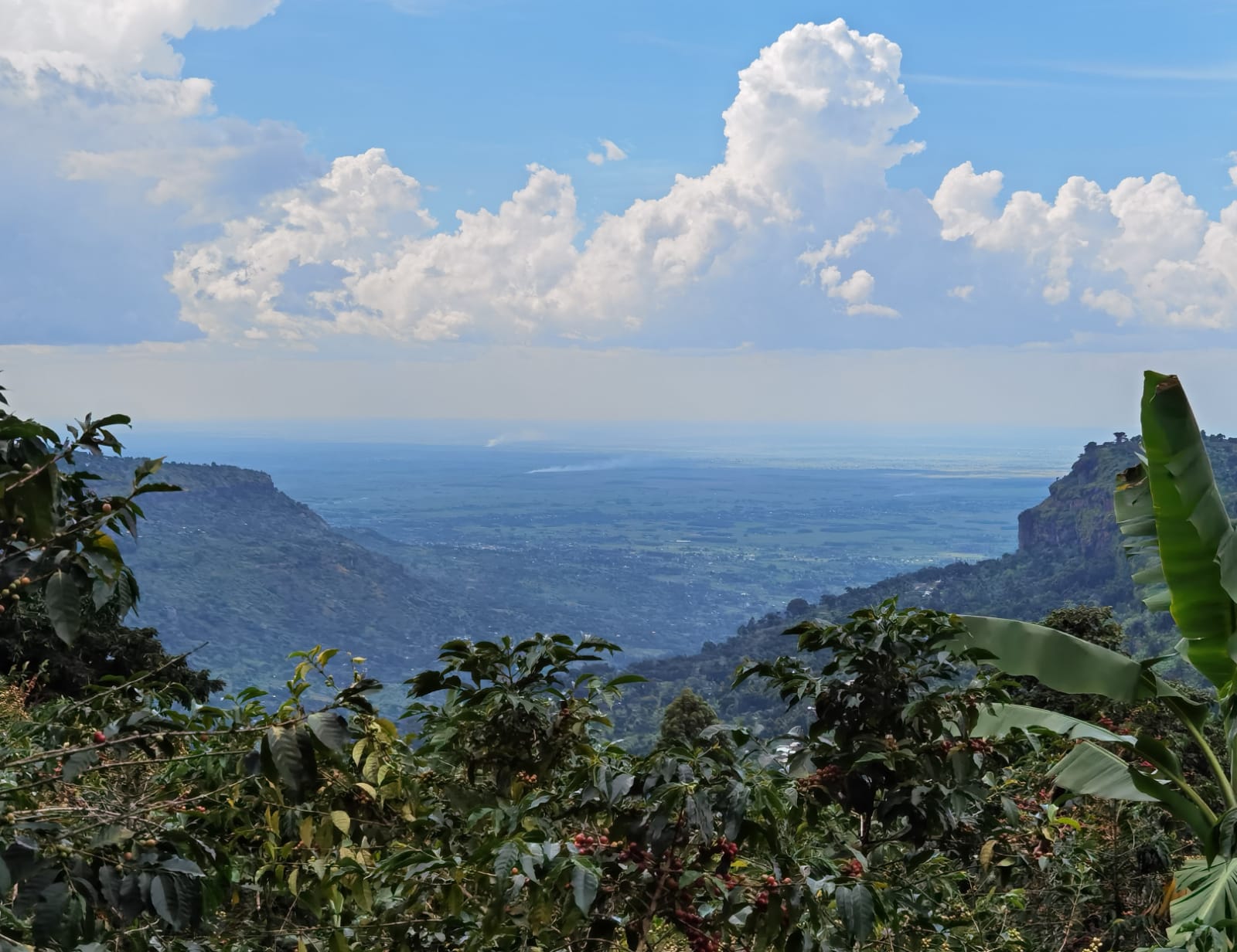
When it comes to Ugandan arabica, Mount Elgon is a must. This is one of the country's flagship arabica growing areas, where the expansion of this species began. This mountain makes the country the second-highest producer of SL in the world, after Kenya.
Mount Elgon lies on the border between Uganda and Kenya. Coffee trees thrive there because "the altitude and climate are ideal for growing SL, 14 and 28. The higher you go, the more SL 28 you find, up to an altitude of 2000 m".
Mount Rwenzori, on the border with Congo
The other important place for arabica production in Uganda is in the east of the country. This is Mount Rwenzori, which separates Uganda from the Democratic Republic of Congo.
On this side of the country, we work mainly with KAPCCO, the Karangura Peak Modern Coffee Farmers Cooperative. All their coffees are Fairtrade certified, with no inputs, as is the case for most farms in the country.
More mixed farming, fewer inputs
Historically, Uganda is a country of small-scale producers, whose land has never merged into large farms like those in Kenya.
Jacques explains that "coffee production in Uganda is organized in the same way as in Ethiopia or Rwanda. The farms are small, with coffee, banana and orange trees. We're talking about mixed farming, small areas exploited to the maximum, in a model close to agroecology.
The use of inputs is severely limited, as in Ethiopia, by the producers' purchasing power.
A little-known alternative to Kenyan coffee?
To build up our range of Ugandan coffees, Jacques went searching for coffees that matched our DNA: quality coffees with a history. "The idea was to find people who make nice processes, honeys, plain and washed coffees. With a particular focus on quality, from production through to the process".
The result is mainly fruity, gourmet coffees. Here again, Jacques says it best: "There's a dark fruit side, with notes of blackcurrant and blackberry. Like Kenyan coffees, but with more roundness and sweetness. And, admittedly, at a lower price".
So why do we know so little about them, despite all their qualities? In Uganda, coffee production is based on individual initiatives, such as those of exporters Masha Quality or Bariguna on Mount Elgon, or the Karangura cooperative on Mount Rwenzori.
According to Jacques, what is lacking in Uganda is "a structured industry supported by the government, intending to developing the export of quality coffees", even though coffee is the country's most important export product.
Did you like this article? Share it with your community: